Compare that to, say, William Beaudine, an insanely prolific, zero-budget hired gun who cranked out endless, soulless genre pictures. Beaudine directed what I would classify as the true low point of Bela's career, 1952's Bela Lugosi Meets a Brooklyn Gorilla. Lugosi's star was long since descended by '52, but this movie has so little going for it that I don't question the producer's decision to slap the star's name in the title and cash in on what little bankability he had left.
Friday, October 31, 2014
What Bela Lugosi can teach every artist
Compare that to, say, William Beaudine, an insanely prolific, zero-budget hired gun who cranked out endless, soulless genre pictures. Beaudine directed what I would classify as the true low point of Bela's career, 1952's Bela Lugosi Meets a Brooklyn Gorilla. Lugosi's star was long since descended by '52, but this movie has so little going for it that I don't question the producer's decision to slap the star's name in the title and cash in on what little bankability he had left.
Wednesday, September 4, 2013
Gillian Welch’s “April the 14th Part 1”: The greatest rock song ever written
Thursday, December 3, 2009
Criticizing Dave Eggers' critique of critics
For someone who seems to be a pretty genuine and decent guy, Dave Eggers inspires a weird range of emotions. I know plenty of people who regard him as the living embodiment of all that’s wrong with modern literature. I know just as many who think of him as the voice of his generation. I have mixed feelings about his work, but I definitely side more with the supporters than with the haters. I have nothing but admiration for the youth writing programs he’s helped foster across the country. I thought his A Heartbreaking Work of Staggering Genius was a very good memoir, even though I disliked its quirky footnotes and meta-textual devices. I like a lot of the work McSweeney’s has done, but I’m not much for its postmodern affectations.
Recently, though, I came across a quotation from Eggers that rubs me every which way but right. It’s from a lengthy 2000 interview in the Harvard Advocate in which a question about “selling out” prompts a passionate response. Eggers makes some excellent points about a particular, poisonous breed of hipster criticism, specifically citing an acquaintance who haughtily dismissed The Flaming Lips because one of their songs was used in an episode of Beverly Hills 90210. He rails against those who would place limits on an artist based on an arbitrary code of authenticity or assail someone’s work to gratify their own egos.
I’m with him most of the way. His irritation with the ever-hypocritical “sellout” refrain is fully justified. His tone is pretty defensive throughout, but that’s at least partially excused by the interviewer’s own palpably smug tone. But when Eggers starts taking broad swipes at the institution of criticism, he loses me in a big way. I find this comment especially galling:
“Do not be critics, you people, I beg you. I was a critic and I wish I could take it all back because it came from a smelly and ignorant place in me, and spoke with a voice that was all rage and envy. Do not dismiss a book until you have written one, and do not dismiss a movie until you have made one, and do not dismiss a person until you have met them. It is a fuckload of work to be open-minded and generous and understanding and forgiving and accepting, but Christ, that is what matters. What matters is saying yes.”
There is so much I disagree with in that passage, I’m not even sure where to start. I guess my biggest problem is with the idea that anyone who hasn’t written a book is unworthy of criticizing someone else’s. He does acknowledge elsewhere in the interview that there are some helpful critics in the world, but still holds that “by and large, the only book reviews that should be trusted are by those who have themselves written books.” So then, if I’m not allowed to dismiss a movie without having made one, am I also unqualified to embrace it? Am I within my rights to complain about my malfunctioning DVD player even though I’ve never built one myself? Is it OK for an author to perform a satirical reading lampooning Dick Cheney (as I saw Dave Eggers himself do in Chicago a few years back) even though the writer has never been Vice President of the United States? Eggers’ stance is elitism masquerading as populism, and I find it disingenuous and insulting.
I’ve been both a working artist and an arts critic for my entire adult life. Few things bug me more than artists casting criticism by “non-artists” as irrelevant. First of all, that suggests that criticism is not, in itself, a form of art. In my estimation, a well-written, well-reasoned piece of criticism can very easily stand on its own as an artistic statement made in reaction to someone else’s artistic statement. If the film writing of folks like Roger Ebert, Nathan Rabin or Jaime Weinman is somehow invalidated because the writers are not filmmakers themselves, then I’ve wasted an awful lot of reading time over the years. (Yes, I know Ebert dabbled in film early in his career, so maybe he gets a pass by the Eggers standard.) Actually, an argument could be made that non-artists sometimes make better critics. People who work within the same discipline can be too close to the subject to view it objectively. I’ve had plenty of conversations with writers whose critique of others’ stories boils down to, “That’s not the way I would have written it!”
Eggers’ statement about his critical “rage and envy” also hits a sore spot for me. One of the most common knocks I hear against the institution of criticism is that all critics are failed artists lashing out against the world that rejected them. Maybe that was true of Eggers, but that doesn’t mean critics as a whole are a spiteful den of vipers – it just means Dave Eggers was a bad critic. As much as I like the idea of some shadowy cabal of critics plotting revenge on the art world like so many scorned supervillains, I think questioning anyone’s motives for writing anything puts one on shaky ground. Heck, half of Eggers’ piece is a defense of making art for money. Critics gotta get that dollar too!
I’ve worked with a lot of critics in my day, and in my experience there is no more enthusiastic group of art lovers in the world. One of the greatest periods of my creative life was when I worked as a music writer for Where Y’at magazine in New Orleans. On at least a weekly basis, one of the other writers would pop some hot new find into the office CD player and insist that the rest of us gather ‘round and share in the glory. Sure, Michael Dominici, the magazine’s Music Editor, sometimes used his podium to utterly savage albums he found lacking, but anyone who heard him gush effusively about relative unknowns like jazz singer Lizz Wright or swamp rock old-timer Joe Barry could have no doubt about how much the man loved music. Mike didn’t scorn or envy successful artists. He celebrated them and made it his mission to share just what made them and their work so special.
Maybe I’m misreading or oversimplifying. I know Eggers is specifically addressing people who turn up their noses at things that are perceived as too unhip or mainstream, but it seems to me that his argument also precludes artistic criticism, at least of a negative bent. Earlier in the interview, he says that “the critical impulse… is to suspect, doubt, tear at, and to take something apart to see how it works. Which of course is completely the wrong thing to do to art.” I disagree. That process describes exactly what Donna Bowman does in her exceptional, ongoing analysis of one of my all-time favorite TV shows, NewsRadio. Some might argue that Bowman’s approach is fussy and overly analytical, but no one could claim that she doesn’t truly love her subject matter. Her in-depth look at what made the show tick makes me reflect on the particular greatness of NewsRadio’s writing, cast and direction, and that only enhances my viewing experience.
In my estimation, Eggers’ stance supports the creation of art but puts strict limitations on how we should evaluate it. If every piece of art is left to bob around the world, seen but unanalyzed, does it even count as art? If we regard every creative endeavor on an even plane and keep our negative opinions to ourselves, don’t we effectively stifle an important, culture-wide dialogue? If we give the failures a free pass on the grounds of being “open-minded and generous and understanding and forgiving and accepting,” don’t we do a disservice to the good and great works sharing the same stage?
Look, I know I’m getting a bit too worked up about a decade-old comment from a writer I generally admire. I really don’t intend any of this as a personal attack on Dave Eggers. He’s a sincere, hardworking writer who’s done as much good for writing in the past decade as just about anyone. It’s quite possible that his opinion has changed in the past ten years. He’s recently given a fair bit of time to The AV Club (my favorite arts publication, if my links weren’t enough of a clue), so it’s clear that he doesn’t eschew the critical establishment entirely. It’s just that I’ve seen too many artists blindly bashing critics over the years, and this piece happened to hit most of my hot buttons.
I understand that it hurts to have something in which you’ve invested your heart and soul assaulted on a public stage. I’ve gotten my share of negative feedback, and it’s never pleasant. It depresses me, angers me and puts me on the defensive. But it comes with the territory. Job evaluations are a part of every career. They help keep us at the top of our games. If my boss at my office job gives me a negative performance review, I don’t have the option of brushing it off as jealousy or ignorance or irrelevancy, even if I believe all of that to be true. Instead, I have to get my act together or risk dismissal. Criticism ideally serves a similar purpose for artists. We don’t have to take every negative word at face value, but we should at least acknowledge that there’s something to be learned from a reasoned critique. It’s just a fact that those who choose to share their art with the public will have it evaluated by the same. If you can’t handle seeing your work torn apart or otherwise “dismissed,” then you may have chosen the wrong path.
By the way, I’m pretty sure I’m authorized to make these comments, because I have written a book. Of course, my book hasn’t yet been published, so maybe I don’t make the cut. It’s a tricky gray area, that.
Note: I briefly posted a slightly different version of this entry earlier, then took it down when I decided it needed some clarification. Apologies if that created any confusion. Though I can't imagine what confusion that would create.
Friday, March 6, 2009
Of David Byrne, Lou Reed and the yawning chasm in the pit of my soul
As often happens, I had a moment of clarity while watching The Colbert Report the other night. Stephen’s guest for the evening was the estimable David Byrne, quirky as ever. Near the end of the interview, Stephen put forth his theory that artists like Byrne are obsessed with not falling into the singer’s famous archetype of the middle class man with the beautiful house, beautiful wife and large automobile. After a moment of reflection, Byrne admitted that he’d spent much of his life terrified of being “normal.” Man oh man, do I ever feel him on that one.
I too am terrified of normalcy. Growing up, I had no doubt in my mind that I would be internationally beloved by the time I was 20. I was certain that I was a remarkable person, and as such, I should always strive to stand out from the crowd. Thus, I wore ridiculous clothes to school, co-founded an oddball rock band, cultivated obscure tastes in film, books and music. I did everything within my power to announce to my small town surroundings that I was Unique and Exciting. If something I enjoyed caught on with the mainstream, I renounced it immediately. The Beatles were like a religion to me in middle school, but when one of the football cheerleaders showed up at school wearing a Let It Be t-shirt during freshman year, I denied them three times before the cock crowed. Being a contrarian became a lifestyle in and of itself.
And now here I am at thirty, not yet famous and slouching steadily toward normalcy. I’m happily married and gainfully employed with a daily commute to the suburbs. I own two cats, a sensible car and, within the next few weeks, my very own house. And good gravy, does it feel weird, particularly the part about the job. I used to read Dilbert and watch Office Space and pity the poor saps who could sympathize with the characters. I was convinced that such a fate could never befall an artist and individualist like me. And yet, here I sit in my cubicle, sneaking in a clandestine blog entry in between mundane, soul-numbing work projects, and I fear myself a cog in something turning.
In that same interview, Colbert suggested that for someone like David Byrne, normal is weird. Byrne essentially agreed, saying that he’d given it a try and it hadn’t really taken. Perhaps that’s why 9-to-5 life has proven so toxic to me. For folks like David Byrne and me – and I’m going to go ahead and put the two of us in the same boat, because self-aggrandizement is one of my favorite pursuits – the mundane is the unfathomable. I’ve had a lot of weird writing jobs in my time, from crafting press releases for a children’s country music singer to playing Frisbee with Hugo the Hornet to leading a séance aimed at resurrecting the ghost of Pete Maravich. For me, none of those experiences is anywhere near as surreal as hiding behind fabric-covered walls eight hours a day while trying to come up with my three-dozenth synonym for “stretchy.”
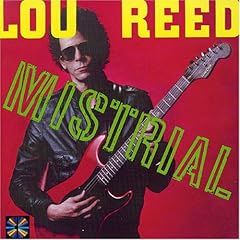
A couple of days ago, I listened to Lou Reed’s 1986 album Mistrial, one of Lou’s bigger critical failures. I don’t think it’s as bad as its reputation, but I can’t deny that it’s a really peculiar, rather difficult album for which I’m seldom in the mood. This time around I finally hit on why Mistrial just doesn’t work: this is the sound of Lou Reed trying to be normal.
Everything about Mistrial is in line with the times, from the overproduced, generic rock to the uninspired, sometimes insipid lyrics. This was the period when Lou was kicking drugs, settling down and putting his prior hedonism behind him. That stab at real-world normalcy appears to have bled through into his art, distilling a reckless, risk-taking weirdo into a second-rate Bruce Hornsby. Simply put, normal just doesn’t work on Lou Reed.
Thankfully, the last couple of decades have seen Lou getting his weird-ass groove back, recording album-length meditations on death, staging gonzo rock operas and writing 18-minute songs about feeling like a possum. Not everything has been a success, but even the failures have been interesting. That gives me hope.
Perhaps normalcy is just a necessary phase imposed upon the abnormal by age and economics. Maybe I’m just serving my short sentence in this fluorescent-humming hellscape, paying my dues because I wanna sing the blues. I take comfort in the knowledge that I still hate this as much as I did the first day I set foot in a corporate office. As long as I can keep myself from getting numb, there’s hope.
And to tell the truth, when I’m behind the wheel of my compact automobile, heading toward my beautiful house and my beautiful wife, I never ask myself, “How did I get here?” That question only arises every morning as I drive in the opposite direction.