Showing posts with label trash films. Show all posts

Wednesday, November 25, 2015

The MST3Konundrum: A trash film aficionado at the crossroads


I can’t say for certain when I first became a fan of “bad” movies. There were a lot of potential gateways back in the late ‘80s and early ‘90s, from the vintage Bela Lugosi clips spliced into Muppet Babies to the release of Tim Burton’s Ed Wood to the sci-fi sampling of bands like Man or Astroman? Heck, even Seinfeld had an early plotline about a screening of Plan 9 from Outer Space. But the real keystone for me and most of my generation was Mystery Science Theater 3000, or as it was frequently known at the time, “That cable show where the little shadow guys on the spaceship make fun of old movies.”


My family didn’t have cable, so MST3K was something of a forbidden fruit to be gobbled up on trips to my grandparents’ house or in stolen moments in friends’ TV rooms. When Mystery Science Theater 3000: The Movie unexpectedly turned up for a brief engagement at a movie theater 45 miles from my house, I cleared my weekend schedule and made it to three out of four late-night screenings. I was excited moving into my college dorm because I’d finally have a cable hook-up on which to watch MST3K, then crushed when I discovered my college’s cable package didn’t include the Sci-Fi channel.


I’ve always been passionate about my favorite art, but not many shows spurred me to that kind of dedication. What was it about MST3K that inspired such fervor? Well, for one thing, it was funny as heck. It was a kind of funny I’d never seen on TV before, yet it seemed oddly familiar. When I learned that MST3K was a Minnesota production, it all made sense. On its surface the sense of humor embodied by Joel Hodgson and the show’s writers was gentle, laconic and borderline corny, but concealed just beneath the surface was the melancholy acidity of a darkness that dared not speak its name. That was the same Minnesota sensibility I’d been drinking in at family gatherings my entire life. It was amazing to see it channeled into something so strange and singular and broadcast for an international audience.


It was the comedy that drew me into MST3K in the first place, but it didn’t take long for me to develop an appreciation for the movies that made the whole thing possible. Much like the sense of humor, the movies mocked by the crew were unlike anything else on my television. MST3K was my first exposure to the weird world of low-budget filmmakers like Bert I. Gordon, Coleman Francis and even Roger Corman. The La Crosse, Wisconsin area didn’t have a “midnight movie” host like Svengoolie, but even if it had, the MST3K repertoire went beyond the usual public domain monster movies and mad scientists, pulling in Italian apocalypsploitation, Japanese kaiju, educational film strips, James Bond knock-offs, biker flicks, kiddie Christmas movies and much more.


At some point I realized I was getting as much pleasure out of the movies themselves as I was from the riffing. Eventually that led me to start seeking out “bad” movies on my own. At my current stage in life, a solid 90% of my cinema intake is stuff that the average viewer would understandably shut off five minutes in. In the past couple of years, I’ve discovered a number of groups of like-minded people both online and in real life. It’s been a lot of fun swapping trash titles with oddballs on Letterboxd, keeping tabs on the Weird Wednesday lineup at Alamo Drafthouse and ducking into my local Trash Film Debauchery and Tape Freaks screenings. As I’ve gotten to know more of these z-movie devotees, I’ve discovered a curious phenomenon: quite a few of them hate MST3K.


I have to admit, I sort of get where they’re coming from. If you’re a fan of something, it’s understandable that you’d resent it being known primarily as the butt of a joke shared by thousands of philistines. In a particularly heartfelt review, for example, Letterboxd user pd187 declares Coleman Francis’s much-maligned The Beast of Yucca Flats “evocative desert noir” that’s “close to a masterpiece for real” before concluding that “mystery science theater is garbage for idiots.” My pal Joe, a sometime MST3K fan and as dedicated a cinephile as I know, recently punctuated a rave review of Rondo Hatton’s The Brute Man with “I don’t know what the inhabitants of the Satellite of Love had to say about this movie and I don’t want to know.”


I haven’t seen The Beast of Yucca Flats or The Brute Man minus the riffing, but I do appreciate many if not most MST3K targets on their own terms. Even the legendarily bad Manos: The Hands of Fate stands as a uniquely realized piece of outsider art. If someone knocked, say, Gamera or Bloodlust or The Crawling Eye as objectively bad films in private conversation, I would be quick to leap to their defense. Yet somehow, I don’t have a problem with them being lampooned on MST3K. I think that’s largely because I sense a genuine affection behind the mockery.


The invective hurled by Joel, Mike, Tom and Crow, especially in the show’s Comedy Central years, feels rooted in an appreciation of the oddness and ambition that got these movies made. You don’t come up with a sketch like “Peter Graves at the University of Minnesota” if you don’t love Peter Graves movies on at least some level. The sheer breadth of knowledge that went into the average episode of MST3K, with non-stop references to pop culture history, scientific ephemera and barely scrutable in-jokes, pegs it as a labor of love.


Still, I’ll acknowledge there are some legitimate knocks to be made against the show’s handling of its movies. Probably the biggest is the editing. Even though the show aired in a two-hour block, making time for commercial breaks, host segments and short films usually meant that the feature’s run-time was trimmed down considerably. In some cases that was arguably doing the movies a service - if you’re not a regular viewer of trash cinema, you have no idea how much mind-numbing padding got stuffed into the movies of the drive-in era. Often, though, that meant cutting material that might be important to the film. Most notoriously, the MST3K version of The Sidehackers deleted a brutal rape and murder scene that was the catalyst for everything else that happened in the movie. It feels somewhat dishonest to mock a movie’s incoherence when you’ve actively made it less coherent.


And then there’s the meanness critique. As much as I think MST3K originated from a place of love, sometimes the barbs got pretty harsh. There are multiple accounts of the Satellite of Love crew drawing the ire of their riff targets. It’s one thing to hear possibly apocryphal stories about big fish like producer Sandy Frank or actor Joe Don Baker grumbling about being ill-treated by TV puppets, quite another to learn about the genuine hurt feelings at a cast screening of MST3K’s take on the homemade dorkery of Time Chasers. Kevin Murphy says no less an icon of empathy than Kurt Vonnegut once gently upbraided him for belittling the efforts of artists just trying to do their best.


I absolutely don’t want to start yet another Joel vs. Mike argument (for the record, I prefer Joel by an inconsequential margin), but I do feel like the show got meaner once Mike moved from the writer’s room into the host’s jumpsuit. As I said before, even when he bared his sardonic teeth, Joel always gave the impression of being a genuine fan of these films. Mike, on the other hand, seemed more interested in putting them in their place. It’s no accident that the motto of Mike’s post-MST3K project Rifftrax is “Because some movies have it coming.” I hold that Michael J. Nelson is the most purely funny person ever involved with Mystery Science Theater, but having read his Movie Megacheese book, I came away with the impression that the guy just doesn’t much like movies unless they’re Jackie Chan vehicles or Roadhouse.


To me, the difference between Joel and Mike is the difference between gently chuckling at a sad-sack friend and pointing and laughing at the neighborhood weirdo. I can certainly see why you’d take issue with that, especially if you happen to be fond of that weirdo. I know I’ve cringed when Rifftrax has taken on movies I genuinely dig, like Death Promise or Attack of the Puppet People. On the other hand, some of the films pilloried on MST3K come awfully close to being objectively bad. Watching The Creeping Terror on its own is a painful slog (although I still have a certain affection for it), and I don’t know if I could even bring myself to attempt the confounding mess of Monster a-Go Go un-riffed. There’s almost zero artistry to a dreary, uninspired Jaws cash-in like Devil Fish, but Mike and his robot friends manage to mine whatever fun there is in the thing.


As a genuine lover of low-grade cinema, I think it’s possible to appreciate both the films and the mockery thereof. I may enjoy the heck out of something like Beginning of the End, but I can’t pretend there’s nothing funny about Bert I. Gordon attempting to pass off grasshoppers crawling across a Sears Tower postcard as a giant insect attack on downtown Chicago. And then there’s that gateway effect I mentioned earlier. Given my general proclivities, I probably would have stumbled into the world of trash cinema sooner or later, but MST3K gave me an easier in-road than I ever would have found poking around the dustier corners of my local video shop.


A fair number of the movies spotlighted on the show would likely have remained in obscurity if not for the exposure they got from their MST3K roastings. Perhaps movies like Manos and Pod People and Space Mutiny would have found tiny cult audiences on their own, but they certainly wouldn’t have become the iconic items they are today. And somewhere down the line, we cross over from laughing at these films to laughing with them. Ask any MST3K fan for an opinion on Zap Rowsdower, the mullet-sporting, denim-draped anti-hero of The Final Sacrifice, and you’ll get not scorn but genuine affection. We love Rowsdower in all his bizarre Canadian glory. Heck, we even put him on our t-shirts. Even the MST3K haters would have to admit that’s a far better fate than languishing unwatched and unloved in the VHS bin of some resale shop.

Thursday, May 7, 2015

Why I wallow in trash: A manifesto for loving unlovable art

In 1984 Donovan released a studio album that included self-covers of his ‘60s classics “Sunshine Superman” and “Season of the Witch” updated with 1980s-style production. Reading that sentence, most people would have one of three reactions: “That’s interesting,” “Who cares?” or “Donovan sucks.” Of those responses, only the third is objectively incorrect. Considering that those re-recordings probably exist only because a weary Donovan realized that revisiting former glories was the most likely path toward getting anyone to care about a new Donovan album in 1984, a curious shrug is about all the response anyone could be expected to muster.
But me, when I stumbled upon the existence of these tracks, I couldn’t get them queued up in my Grooveshark (R.I.P.) playlist quickly enough. They're as bad as you'd expect, but this doesn't bother me one bit. This is my curse. When I learn about an absurd, ill-advised or quintessentially inessential piece of art, I simply can’t help myself. I need to incorporate it into my vocabulary. Zager & Evans followed up “In the Year 2525” with a song about a rapist crucifying himself in a jail cell? One of the guys from Jan & Dean recorded a pro-Vietnam answer track to “The Universal Soldier”? The Royal Guardsmen laid down a decades-late sequel to “Snoopy vs. The Red Baron” in which Charlie Brown and Snoopy hunt down and kill Osama bin Laden? Yes, I am going to listen to these songs. I am going to listen to these songs many times over.
It’s more than just curiosity for me. Knowing about songs like this inspires a peculiar drive in me. The same applies to bizarre film productions like Billy the Kid vs. Dracula or The Rats are Coming! The Werewolves are Here!  I’ll let any number of certified classics and new gems go unheard while I track down a recording of Jim Backus singing “Cave Man.” Given the choice between experiencing something perfect and beautiful and something flawed and inimitably weird, I’m siding with strangeness at least six times out of ten.
This might sound like ironic appreciation, the calling card of the dreaded hipster, but I think it’s something quite different. In my younger days, sure, I’d watch bad movies and buy novelty albums for the sole purpose of mockery, and I’m always going to love Mystery Science Theater 3000 above most things. But as I’ve grown older the irony has ebbed and I find myself appreciating these things in their own right. I’d say I love them for what they are, but that’s not quite it. I love them because they are. Knowing that these things are out there, that someone took the time to create them and shepherd them into existence despite their obvious lack of broad appeal, is a fascinating, inspiring thing to me.


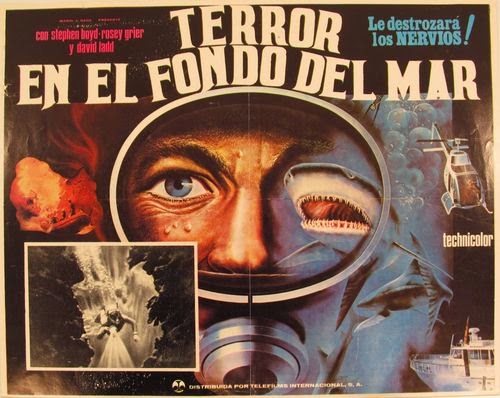
And it isn’t only the weird stuff either. I just finished watching Treasure of Jamaica Reef (aka Terror in the Deep), a very cheap, very boring 1975 movie about a group of divers (including Cheryl Ladd and Chuck Woolery) trying to salvage a fortune from a sunken ship. It isn’t good. It isn’t “so bad it’s good” (a phrase I loathe). It doesn’t even have the same weirdo appeal as the aforementioned novelty songs and trash films. It’s just a movie that exists, badly made and eminently forgettable. There is no reason I should have watched it, and that’s exactly why I did. (If I might digress for a moment, I've had some debates about the term "trash." Some fans of this type of stuff feel that term devalues the art. I suppose it rather literally does, since trash is by definition material of little to no value. But I think it's appropriate, inasmuch as most of the public absolutely regards these songs and films as worthless. Also, a lot of the art that gets tossed under the "trash" umbrella was specifically designed to be disposable - quickie singles recorded by session musicians to cash in on a passing fad, no-budget genre films intended as background noise for teenage drive-in patrons, hasty projects knocked out to fulfill a contract or qualify for a tax break. I'm fine with using "trash." In fact, I consider it a badge of honor.)
I want there to be some evidence that movies like Treasure of Jamaica Reef are out there. I want art to be eternal, no matter how uninspired or poorly made. My Letterboxd account is a hall of low-budget obscurities ranging from the incompetent to the derivative to the inexplicable, most of which are unloved and unknown by the world at large. Obviously not many people want to watch these movies, or listen to late-period Donovan albums, or obsess about the musical careers of Dino, Desi and Billy. Honestly, most people shouldn’t. But I think it’s important that someone does, because these artifacts are a part of our artistic heritage too.
Are they as vital to our shared experience as their canonically classic contemporaries? Of course not. But we do ourselves a disservice if we leave the ugly and the unremarkable to molder in the grave. I feel my artistic life has been deeply enriched by the time I’ve spent in the company of these misfits. I can make a lucid argument for scabrous trash auteur Roberta Findlay being one of the most important female directors in American film history. I can sing every word of The Coasters’ On Broadway album, the novelty band’s unjustly ignored assay into straight-up Southern funk. I know who LeSesne Hilton and Bennie Robinson and William Metzo are, and why each of them deserves a place among the great cinematic villains of the 1970s. I also know that there are many, many worse movies than Plan 9 from Outer Space or The Room or Birdemic or whatever the de facto “Worst Movie Ever Made” is at the moment. I’ve subjected my eyes and ears to a lot of irredeemable, uninteresting, soul-deadening dreck over the years, but I don’t regret a second of it. These things are out there and they need to be kept alive, even if only inside my cluttered brainpan.
All those classics of Western Literature can just slide to the back. We need that space for Shriek of the Mutilated.

Sunday, July 1, 2012

Andy Milligan is ruining me: A trash film fan finally meets his match


I’ve mentioned before how influential the Videohound Golden Movie Retriever was in shaping my cinematic tastes, partially because it alerted me to the existence of so many obscure films with wonderfully elaborate titles. I’ve been slowly tracking down my favorites over the past decade, always taking an unreasonable amount of joy in finding a terrible transfer of a film like Door-to-Door Maniac or The Severed Arm. When I recently discovered the long sought-after The Rats Are Coming! The Werewolves Are Here! tucked away in my beloved Internet Archive, I was beside myself. Little did I know that I was opening the door to perhaps the grimmest chapter in my life as a film buff.


See, TRAC!TWAH! was directed by one Andy Milligan. That didn’t mean anything to me when I started watching it, but it’s become highly significant in the subsequent weeks. Andy Milligan, as it turns out, is something of a notorious figure in the world of trash cinema. He started out making arty exploitation films (none of which I’ve been able to track down… yet) but is now probably best known for his peculiar brand of horror. He’s sort of a poor man’s John Waters, a gutter-dwelling auteur with a unique vision, an unmistakable style and a thirst for sleaze. The big difference is that Milligan lacked the playful wit and self-awareness that made Waters an icon. In its place lay a gaping chasm of bitterness and loathing.

By all reports I’ve read, Andy Milligan was a very unpleasant person. The product of a broken, abusive home (and, on a personal note, a native of my current hometown of Saint Paul), he was reputedly a mean, misogynistic sadist who used his art as an outlet for all of his worst tendencies. There are plenty of artists out there who fit that profile, but there aren’t many who approached their art so vigorously or viciously. Andy Milligan made movies like he was mad at the very existence of film. His cinematic world is an unholy marriage of spite and incompetence, but I’ll be damned if I don’t find it strangely compelling.


And “compelling” really is the only word for it. I don’t watch Andy Milligan movies because I enjoy them, or because I think they’re an important piece of my pop cultural education. I watch them because, now that I know they exist, I feel weirdly driven to subject myself to as many as I can. “Subject” is also the right word, because these movies are not fun to watch by any recognizable measure. Here are a few things you can expect from your average Andy Milligan movie.

Elaborate period costumes that feel slightly “off.”
Milligan apparently loved making clothes and proudly handled costume design for most of his films, despite being only OK at it.

Endless, breathless conversations with little to no bearing on anything.
In Milligan’s world, couples and families spend most of their free time talking and talking and talking in florid language about one of two topics: how much they love each other or how much they hate each other.

Exposition. So, so much exposition.
When they’re not waxing purple about love and hate, Milligan’s people are helpfully filling us in on back story with a heavy handedness that would make a Law & Order writer retch.

Physical abuse of a male invalid.
As I mentioned, Milligan was a real-life sadist. His dedication to filming his fetishes makes Quentin Tarantino’s obsession with ladies’ feet look downright subtle.

Really bad gore effects.
Onscreen gore was still coming into its own during Milligan’s late ‘60s-early ‘70s heyday, but his low-grade splatter wouldn’t have passed muster in even the earliest Herschel Gordon Lewis features.

Awful monster make-up.
Not every Milligan movie has a supernatural plot, but those that do tend to end up with somebody donning a really unfortunate werewolf mask or goofy vampire teeth.

The darkness.
I think I’ve covered the figurative darkness of Milligan’s films already, but they’re also physically dark, to the point that it’s often impossible to suss out what the hell is happening onscreen. That’s not always a bad thing.

All of that might give you the impression that Andy Milligan made “so bad it’s good” movies. (I’m not a fan of that term in any situation, but getting into that would require too much digression.) That isn’t the case. Andy Milligan made bad movies, plain and simple. They aren’t fun to watch, nor are they memorable in the way transcendently bad films like Frankenstein Island or the Ed Wood oeuvre are. He’s the rare director whose films are improved by distraction. I often wash dishes or perform other household chores while tackling a Milligan.

Nevertheless, Milligan’s films are fascinating to me because they reflect an undeniable artistic vision. Nothing else looks or feels quite like an Andy Milligan movie. Guru the Mad Monk and The Ghastly Ones, to pick two random examples, are set centuries apart on different continents, and filmed with an entirely different cast. Even so, the production and tone of both films are so similar that they’re unmistakably the work of the same creator.


There just aren’t many directors who can place such an inimitable stamp so plainly across a three-decade body of work. When I think of truly distinctive directors like, say, Robert Altman or Frederico Fellini, I can usually also point to a slew of knock-offs and homages that get the style almost but not quite right. Even legendarily “bad” directors like Ed Wood and Bert I. Gordon, for all their distinctive trademarks, don’t stand nearly as far apart from their peers as does Milligan. I can’t even imagine how you’d approach making a Milligan rip-off, although it has been done. Odd as it may sound, I find that kind of dedication to one’s own artistic vision – even a cruel, monotonous, incoherent one – immensely inspiring.

I’m not alone in my unfortunate appreciation of Mr. Milligan. He’s inspired at least one book-length biography and a slew of blogs and essays. (My personal favorite is Joseph A. Ziemba’s dishearteningly thorough rundown of Milligan’s horror films for bleedingskull.com.) He also has a celebrity champion in Drive director Nicolas Winding Refn, who has dedicated a great deal of time and money to getting Milligan’s films back into the public eye. I’ve noticed that there don’t seem to be a lot of casual Milligan fans. There are those who remain blissfully unaware of his body of work, and there are those who become obsessed by it.

Once you have a few Milligans under your belt, you can even begin to find some pleasures in them. For instance, I don’t know if John Miranda’s bitterly unhinged performance as Sweeney Todd in The Bloodthirsty Butchers is really all that good, but seeing someone act with even a hint of nuance felt like a revelation after watching dozens of other Milliganders alternate between lifelessness and histrionics. Likewise, if I’d gone into Blood cold, it may not have made much of an impression on me. Seeing it after a string of even shoddier Milligan films, however, made its relative – very relative – competence feel like a blessed relief.


Note before you click: This is not just a clip. This is the entire movie. You may not be able to extract yourself once you enter.

So what do I want you to take away from this little essay? Hell, I don’t know. Maybe I just wanted to share the misery. Maybe this is my way of trying to get a grip on what I find so inspiring about this dreadful body of work. Maybe I just want to know that something has come of the hours I’ve dedicated to Andy Milligan while countless genuine classics remain unseen by my eyes. One thing I know for certain: there’s a full-length print of Milligan's reputedly unwatchable Surgikill up on YouTube right now that demands my attention. Please keep me in your thoughts and prayers.

Special thanks to my man Joe Gibson for alerting me to that Nicolas Winding Refn article, and for putting up with my regular Milligan venting on Twitter.